The Gist
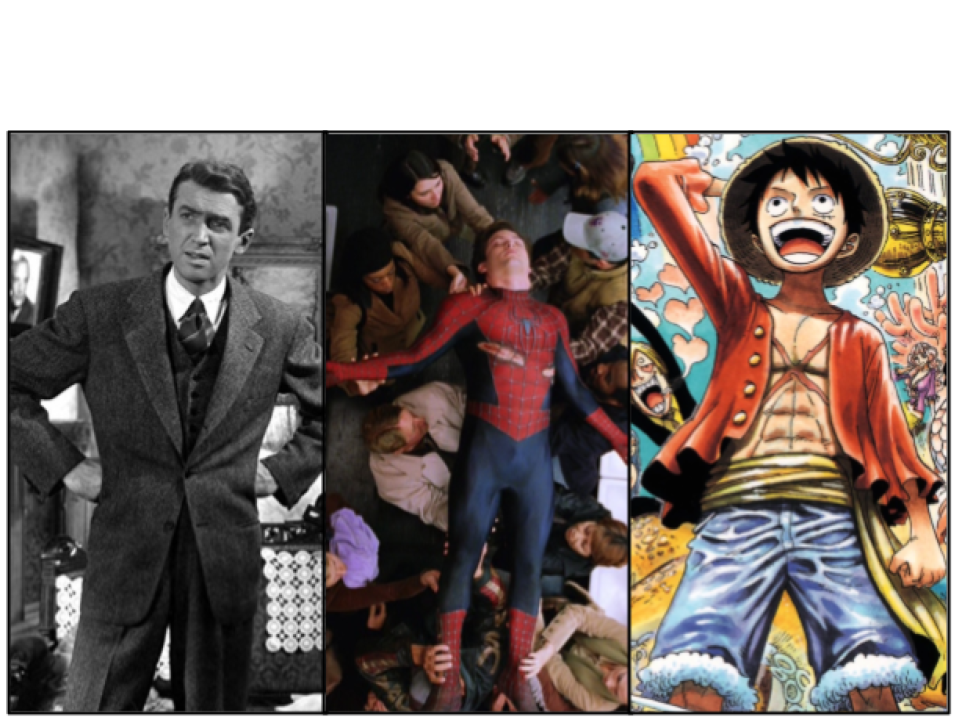
I often struggle with the question of what it means to be a “good person”. In my first-year writing seminar in college, we discussed normative ethics, the philosophical discipline that looks at morality. Though I could appreciate the rationale for deontology and consequentialism, virtue ethics stood out to me. To have virtuous characteristics and be of good moral character. That’s how you be a good person. To be a good person is to, as they say in Adventure Time, have a “Hero Heart”.
Looking across popular media, I have found three people I have deemed as living by ideals worth emulating, each with varying levels of happiness. Here, I look at the virtuous characteristics of Peter Parker (The Amazing Spider-Man), George Bailey (It’s a Wonderful Life), and Monkey D. Luffy (One Piece) and the effect their pursuit of virtue has on their lives and the lives of those around them.
The Characters:
Peter Parker
Spider-Man is a hero. Beloved by many in New York City, he saves the day, carrying with him an ideal left to him by his Uncle Ben. “With great power comes great responsiblity” (or the more comic accurate version “With great power there must also come — great responsibility”). This ideal of “responsibility” pushes Peter to save people. In his eyes, one who fulfills their responsibility to those around them is doing “the right thing”. This responsibility just happens to be proportional to what they are capable of doing, and as a result, a super-powered individual like Peter Parker has a large amount of responsibility.
YouTuber schnee has an amazing video that looks at what it means to be a traditional Spider-Man from the lens of the Spider-Verse movie franchise. In the video, he examines the traditional Spider-Man origin story and how it motivates the character’s heroism through a sense of “moral debt”. He argues that the traditional Spider-Man story follows the same format: an individual is bitten by a radioactive spider, given super powers, fails to save someone close to them, and spends the rest of their life using their powers to repay the moral debt they acquired by failing to save a loved one.
As a result of these events, Spider-Man is externally driven. He is still virtuous, doing the “right thing” and knowing in his heroic heart what that means, but he does not perform heroic acts for the sake of heroism. In The Superior Spider-Man (2013-2014) comic series, when long-time foe, Otto Octavius, has switched bodies with Peter Parker and parades around as Spider-Man, a remnant of Peter Parker’s mind that still exists in his previous body explains to Otto that to be Spider-Man means always doing the right thing.

But he does not do it because he likes to or wants to. He doesn’t get real joy from being Spider-Man. Actually, his pursuit of paying back his moral debt through good deeds and lives saved makes him miserable. In Amazing Spider-Man Volume 2 issue 35, Peter Parker cries on a rooftop alone and prays to God, asking for a break from all the suffering he has been forced to endure over the years.

Spider-Man is a hero. Peter Parker is a hero. Deep down, he’s a good guy who sticks his neck out to save lives and better the world for those around him. But he doesn’t want to be. He has to be. He has a debt to pay, and in his quest to pay this debt, he exhibits virtuous characteristics at the cost of his own happiness. To be Spider-Man, even if you’re being a hero, is to be unhappy.
George Bailey
George Bailey is a hero. To the small town of Bedford Falls, New York, where George Bailey, the protagonist of It’s a Wonderful Life, lives, he is an anti-capitalist saint that puts the needs of everybody else above his own.
From a young age, George saves multiple lives. Not even metaphorically. Before he’s eighteen, he saves his brother from drowning and stops the neighborhood pharmacist from accidentally poisoning someone. Though he makes mistakes in his life and does some not-so-virtuous deeds along the way, he throws away his dream of leaving Bedford Falls, his chance to go to college, and his honeymoon all in the name of keeping his family-run, community-centered Building and Loan operational.
When the towns local capitalistic banker, Henry F. Potter, tries to buy up more of the town, George begins the creation of a housing development so the townspeople can afford and own their own homes. When his uncle or brother need him to stay in town to watch over the business, he gives up his dreams of traveling the world in order to do so. When there’s a run on the Building and Loan because the townspeople are worried about their money, he pays them enough to get by with cash that was meant for his honeymoon.
Time and time again, George, like Peter Parker, lives a life of sacrifice. He gives up his money, his youth, and his ambitions all for the sake of fighting for the people he loves and the community he grew up in. He knows and trusts the people he lives with and asks that the community look after each other in the face of Mr. Potter’s individualistic greed. And in his darkest hour, when the Building and Loan, the last local institution that opposes Potter, loses thousands of dollars due to a misplaced deposit, George even considers giving up his own life so others could use the payout from his life insurance policy to keep the business running.
In the end, George is saved both monetarily and spiritually. As he plans to kill himself, an angel shows him what the world would have been like had he never been born. George walks through a nightmarish world where his brother is dead, his wife is alone, and his town has become Pottersville. Upon going back to the real world, George has a new lease on life, realizing that Bedford Falls is a better place because he was a part of it for all these years. He gleefully rushes home and is surprised when the people of Bedford Falls, hearing about his financial troubles, arrive with money to help him out. Just as George saved the town, the people of the town save him.
Though he resented his life moments before his potential suicide, in the end, George Bailey finds happiness, realizing that the sacrifices he made led him to his wonderful life.
Monkey D. Luffy
Luffy is a pirate. In the world of One Piece, a pirate is usually a bad guy. They torment, steal, destroy, and kill. But Luffy is notably different from other pirates in his world. Luffy puts his life on the line to save people. Hopping from island to island, Luffy and his crew take down tyrannical leaders, liberate oppressed people, stand up for the dreams of others, and stop villanous pirate groups from harming civilians.
Time and time again, Luffy is seen as a beacon of light in the world of One Piece. A savior to many, he fights the bad guys that nobody else can. As a result, many see Luffy as a hero. But Luffy is not a hero. He even says so himself.

Luffy is a pirate. He does what he wants when he wants, and his expressed goal is to be the freest person on the seas. That said, Luffy has a strong moral compass, so what he wants to do often aligns with dethroning oppressive rulers and helping innocent people. So, even though he is a pirate, he does heroic deeds.
That said, Luffy also acts selfishly at times. When his brother Ace is in prison, Luffy infiltrates the prison to try to free Ace, and as a result of this break-in, he frees numerous prisoners. Some may see this as a positive because he is liberating them, but many of these prisoners are the types of villanous pirates Luffy fights. They hurt people and terrorize towns. Though Luffy is not aligned with them or their morals, he nevertheless has no issue releasing them and allowing them to wreck havoc on the world if it means he can save his brother.
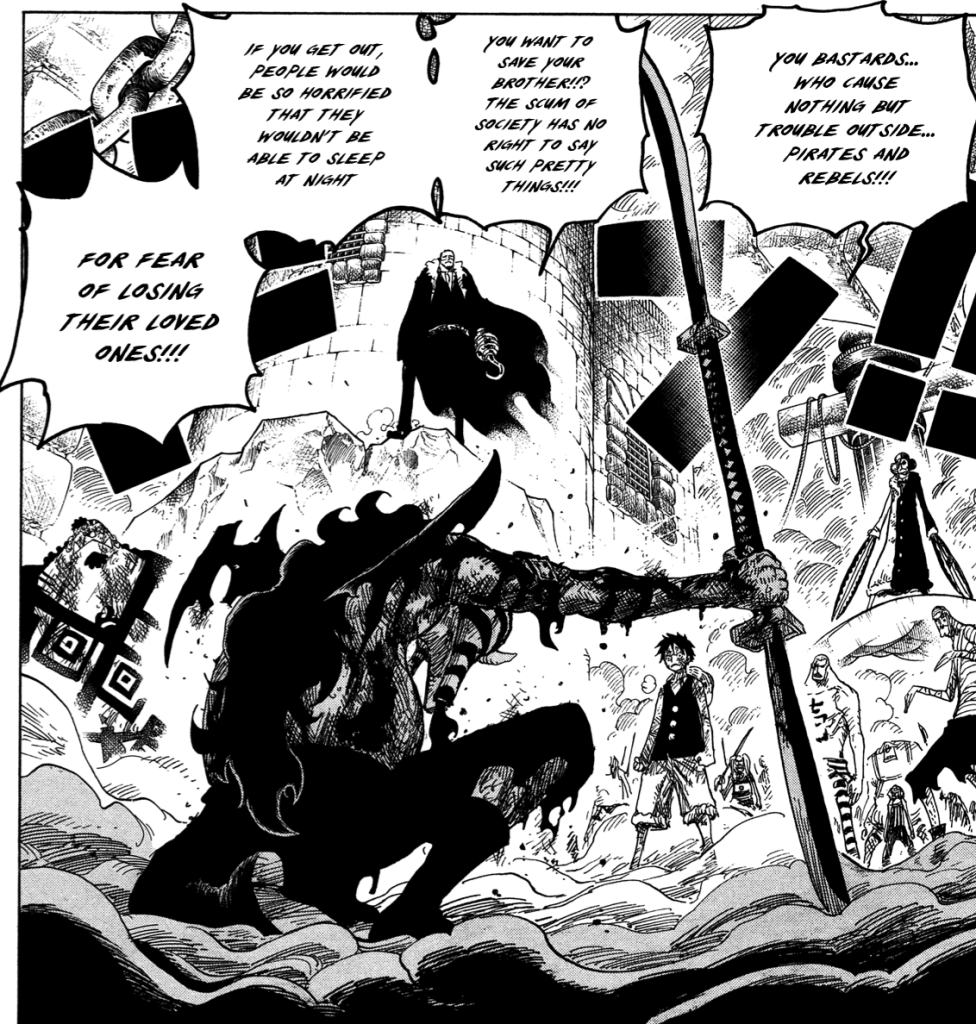
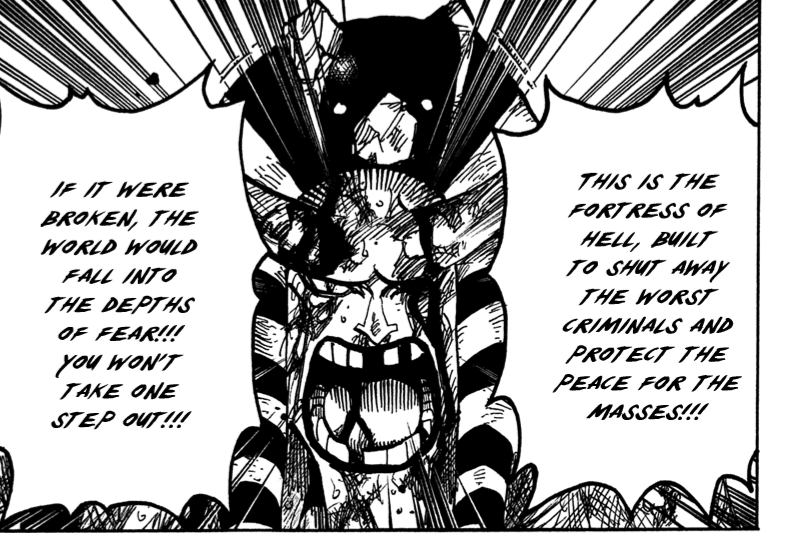
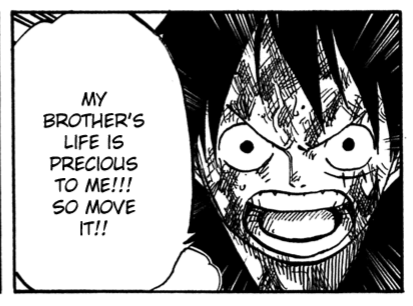
Though Luffy has a strong moral compass and does many heroic deeds, he does not compromise on what he wants for the sake of others. What he wants only aligns with what is best for those around him because he is a good person who cares about the well-being of other people, not because he is trying to do the right thing at all costs. In the end, like all the pirates who hurt people, Luffy is selfish. He saves people, but he wouldn’t do it if he didn’t want to. Yet Luffy goes from island to island, putting his life on the line along with his loyal crew, and he lives happily.
Finding Happiness in Goodness
I present these three characters because they all showcase virtuous acts, but have different levels of happiness.
Peter Parker is miserable, but he saves people for the sake of paying off his moral debt and fulfilling a sense of responsibility.
George Bailey is resentful of his life until he is shown a world where he never existed because the people he loves (and that love him) were saved by his lifetime of sacrifices.
Luffy is happy and saves people from oppressive forces, but he is willing to let bystanders get hurt as collateral damage for him acting as he wishes.
Looking at these three, I derived two main axes by which to determine the cost of “goodness” on happiness.
Axis 1: Want
The first axis is “want”. Do you want to do the virtuous/morally upstanding thing? Are you inherently drawn to doing what you think is morally right, or are you doing what is morally right because you feel like you have to? In Luffy’s case, he is happy because he does what he wants. In Peter Parkers case, he is unhappy because he does what he has to do. His lack of wanting to do the right thing means he is miserable because of the opportunities he is forfeiting in order to fulfill his role.
Similarly, when George Bailey is resenting his life choices, it is because he saw them as things he had to do. He feels as though he was forced into the role of “Guardian of Bedford Falls” instead of being allowed to do the things he wanted to do throughout his life. In the end, Luffy is happier than both of them because Luffy’s virtuous deeds are never contrary to what he wants to do.
Axis 2: Perspective
All of this said, George Bailey ends the movie as a happy man. Thus, the second axis is “perspective”. Peter Parker looks at his life as a series of miseries. He asks God to go easy on him because even though he is gifted, he does not see the hand he was dealt as a gift. Even though he can choose to stop being Spider-Man at any time, he still believes he is trapped by his responsiblities. Luffy on the otherhand sees everything as a choice. He emphasizes freedom in his life. If he wants to do something, he does it, and if he doesn’t want to do something, he doesn’t do it. From this perspective, life is a series of choices by which Luffy chooses to do what he thinks is best. He is self-sacrificing, but only because he chooses to be. Even if he dies, Luffy works to live a life without regret.

George Bailey, similar to Peter Parker, feels a lack of agency. Time and time again, fate worked against him, and he did not get to live the life he wanted. Unlike Luffy, George Bailey does not see himself as free. Only when George accepts the life he has (regardless of how he got there) does he realize he has a wonderful life. George stops comparing his life to the one he could have had if everything he wanted went “right”, and begins to compare his life to the one where everything went “wrong”.
Like Spider-Man and Luffy, George made his choices for a reason. Though he felt stuck, like Peter Parker, he was ultimately choosing his path with the betterment of others’ lives in mind. Knowing what the world would look like if he didn’t do the right thing time and time again, George realizes that he was never stuck. He chose the life he lives now, and he’s happy that the people around him are living better lives because of the sacrifices he had to make. His perspective changed when he understood that the choices made had paid off, exactly as he intended them to. As a result of this perspective change, the life he sacrificed was no longer a cost he resented paying in order to get his current life, even if his current life is not his ideal life.
Final Thoughts
In an ideal world, our wants are aligned with the “right” thing to do. “Goodness” comes at no cost to us because what we want is goodness and the outcomes of doing the right thing. But, in the off chance that doing the right thing means sacrificing what we feel would make us happiest, we are not at a total loss. We have autonomy and we make our choices for a reason. In the end, we may do the right thing because we feel like we have to. But maybe we do it because fulfilling that role or responsiblity matters to us. Maybe we do it because making the world a better place for everybody to live matters to us. And if we look at what our world is today because we did the right thing rather than look at what our world could have been if we didn’t, the cost of being a good person becomes next to nothing.
I like to believe I naturally want to be good and do the right thing. That I’m okay with the cost of acting the right way because it’s innate in me and I have a hero’s heart. But sometimes, when I do the “right” thing and it requires sacrificing for the sake of others, I find myself asking, “but what about what I want?” But it helps to remind myself that I wouldn’t have made sacrifices in the name of “what was right” if I didn’t want to. And just like that, I realize I got what I want. Not everything I wanted, but what I was able to get, even at the cost of something else I may have wanted. I got the world I wanted, and I chose it the moment I decided what action was right and what was wrong.
Considering it all together, if we’re able to live along these two axes in our search for goodness, then all we have left to do are follow the wise words of Da Mayor:
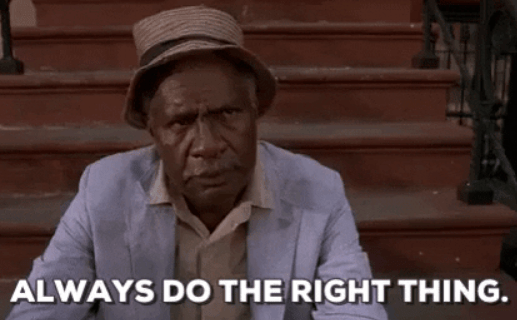
Do The Right Thing (1989)
 Matt Ivler
Leave a comment