Economies of Scale in School Districts
In my second year of college, I took Econometrics as part of my Economics degree. The class concluded with a semester-long project about any economic/social science research topic you were interested in exploring. Having come from a large public high school (~3200 students) that acted as the only high school in my school district, I decided to look at the effect of Student-to-School ratios on the success of students (proxied with graduation rates) on the school district level.
Though my professor at the time had trouble understanding it, I hypothosized that there were economies of scale to be found by having more students per school in each district. This seems contrary to the conventional wisdom that classrooms with fewer students have more successful students because the teacher can put more time into each student.
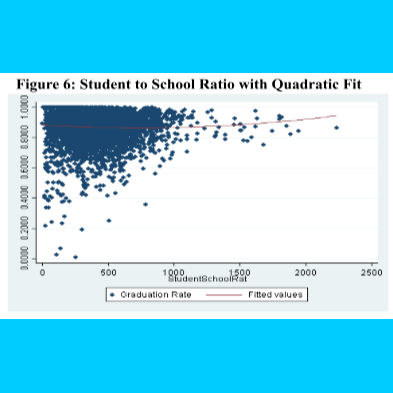
Ultimately, my research found that my hypothesis was correct. Higher student-to-school ratios in a district did have a positive effect on district-wide graduation rates. My literature review found some explanations to support this. First, schools need a certain amount of students to warrant adding a new class. This meant that, if a school had enough people in need of an intermediate English class, then they could create various levels of the same 10th grade English class and provide students with the proper class level based on needs. Additionally, the literature indicated that no matter how big a school gets, most classrooms will not exceed 40 students. In other words, more students means more stratified class levels that can meet student needs while not leading to endless growth of classroom sizes. As a result, more students in a school meant more students could get an education that fits them without students losing out on the benefits of managable class sizes on their education.
To read the paper and learn more about the empirical and literary analysis, click here
 Matt Ivler